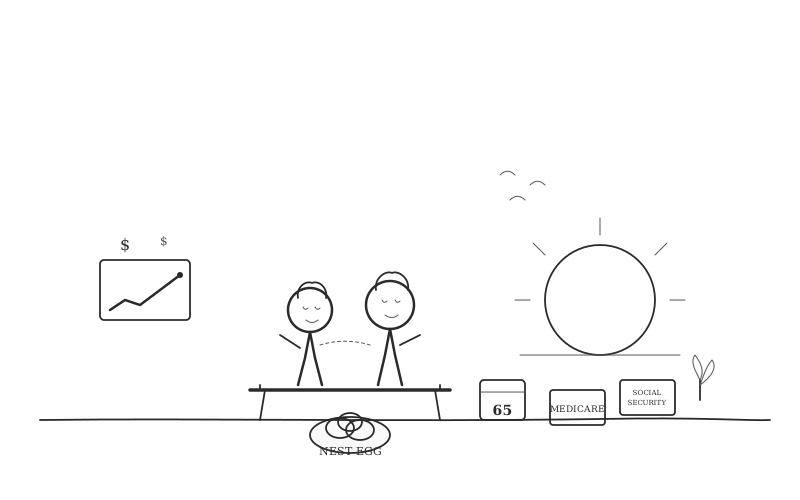
1. The Financial Reality of Retirement in 2026
Approximately 10,000 Americans turn 65 every day — a wave that will continue through 2030 as the baby boomer generation fully enters retirement. According to the Federal Reserve's Survey of Consumer Finances, the median retirement savings for Americans aged 55-64 is $255,200. At the traditional 4% withdrawal rate, this generates $10,208 per year — or $851 per month. Combined with the average Social Security benefit of $1,976/month, the typical retiree has approximately $2,827/month ($33,924/year) in retirement income. For a worker who earned $75,000 annually, this represents a 55% income reduction.
Want to see how this fits YOUR situation? Try the Retirement Decision Support Engine →
The retirement income gap — the difference between pre-retirement income and retirement income — averages 30-50% and is the central challenge of retirement planning. The gap must be filled by some combination of additional savings withdrawals, part-time work, spending reduction, or lifestyle adjustment. Retirees who plan for this gap 3-5 years before retirement navigate the transition successfully. Those who discover it on day one face an immediate financial crisis with limited options to resolve it.
The challenge is compounded by longevity. A 65-year-old couple has a 50% probability that at least one spouse will live to age 92 and a 25% probability of one reaching 97. This means retirement savings must last 25-32 years — not the 15-20 years that most people intuitively plan for. Running out of money at 85 with 10+ years of life expectancy remaining is the retirement nightmare scenario, and it affects approximately 12% of retirees according to the Employee Benefit Research Institute.
Retirement is also the life event with the most moving parts: Social Security claiming strategy, Medicare enrollment, 401(k)/IRA drawdown, tax-efficient withdrawal sequencing, required minimum distributions, healthcare cost planning, long-term care insurance, estate planning, housing decisions, and income replacement. Each decision interacts with the others, and mistakes are often irreversible — you cannot undo a Social Security claiming decision, recoup a Medicare late-enrollment penalty, or recover from an early-retirement savings depletion. This guide addresses every decision in the right order.
2. How Much Is Enough? The Retirement Math
The most common retirement planning rule is the 4% rule: save 25 times your annual retirement spending, and withdraw 4% per year (adjusted for inflation). If you need $60,000/year in retirement spending, you need $1.5 million in invested assets. The 4% rule was developed by financial planner William Bengen in 1994 using historical market returns and has been validated across nearly all 30-year periods in U.S. market history — including periods that included the Great Depression, the 1970s stagflation, and the 2008 financial crisis.
But the 4% rule assumes a 30-year retirement and a diversified portfolio of 50-75% stocks / 25-50% bonds. For early retirees (before 60), a 3.5% withdrawal rate is safer for a 35-40 year horizon. For late retirees (after 70), a 4.5-5% rate may be appropriate for a shorter horizon. And the rule is a starting point, not a mandate — flexible spending (reducing withdrawals during market downturns, increasing during bull markets) has been shown to increase portfolio survival rates to 95%+ compared to 85-90% for rigid 4% withdrawals.
The Social Security offset: You don't need to fund your entire retirement from savings. Social Security replaces approximately 40% of pre-retirement income for average earners, 28% for high earners, and 55% for low earners. A retiree who needs $60,000/year and receives $24,000 in Social Security only needs savings to cover the $36,000 gap — requiring $900,000 in savings at the 4% rule, not $1.5 million. Similarly, a pension, annuity, or rental income further reduces the savings requirement. Calculate your actual gap: (target retirement spending) minus (Social Security + pension + other guaranteed income) = the amount your savings must generate.
The spending trajectory: Retirement spending is not constant. Research from the Bureau of Labor Statistics shows that retirees spend more in early retirement (65-74) on travel, dining, and activities — the "go-go" years. Spending declines in the "slow-go" years (75-84) as activity levels decrease. Then spending may increase again in the "no-go" years (85+) due to healthcare and potential long-term care costs. A retirement budget that accounts for this trajectory — front-loading discretionary spending and reserving funds for healthcare in later years — is more realistic than a flat annual number.
3. Social Security: When to Claim (The $164,000 Decision)
The Social Security claiming decision is the single most consequential financial decision most retirees make — and it is irreversible (with a narrow 12-month withdrawal window that most people don't know about). You can claim as early as age 62 (at a permanently reduced benefit), at your Full Retirement Age (FRA) of 67 for those born in 1960 or later (at your full benefit), or as late as age 70 (at a permanently increased benefit of 124% of your full amount).
The numbers: a worker entitled to $2,000/month at FRA 67 receives $1,400/month at age 62 (a 30% reduction), $2,000/month at 67 (full benefit), or $2,480/month at 70 (a 24% increase). The difference between claiming at 62 and 70 is $1,080/month — $12,960/year — for life. Over a 20-year retirement (to age 82-90), this difference totals $164,000-$259,200 in cumulative benefits. For a married couple where both spouses have significant earnings, the combined lifetime benefit difference can exceed $300,000.
The break-even analysis: The break-even age — the point at which total benefits from delayed claiming exceed total benefits from early claiming — is approximately age 80-82 for the 62-vs-70 decision. If you live past 82, delaying was the right choice. Since the average 65-year-old has a life expectancy of 84 (men) to 86 (women), the odds favor delaying for most healthy individuals. For married couples, at least one spouse should delay to 70 — because the higher earner's benefit becomes the survivor benefit when one spouse dies. A widow or widower receives the higher of their own benefit or their deceased spouse's benefit. If the higher earner claimed at 62 ($1,400/month) and dies, the surviving spouse receives $1,400/month. If the higher earner waited until 70 ($2,480/month), the survivor receives $2,480/month — a $1,080/month difference that lasts for the survivor's remaining lifetime.
When to claim early (age 62): Claiming early makes financial sense if you're in poor health with shortened life expectancy, you need the income immediately and have no other sources (no savings, no bridge income), you're married and have the lower Social Security benefit (while the higher-earning spouse delays), or you want to invest the early benefits and can reliably earn returns exceeding 6-8% (the effective rate of return from delaying). The common mistake: claiming at 62 because "I might not live that long" or "I want to get my money while I can." Social Security is longevity insurance — it protects against the risk of living longer than your savings last. Claiming early reduces that protection at exactly the moment you'll need it most.
Spousal benefits: A spouse who earned less (or didn't work) can claim a spousal benefit equal to up to 50% of the higher-earning spouse's benefit at FRA. The spousal benefit is only available once the higher-earning spouse has filed for their own benefit. If the lower-earning spouse has their own work record, they receive the higher of their own benefit or the spousal benefit — not both. For a couple where one spouse earned $2,500/month at FRA and the other earned $800/month, the lower-earning spouse receives $1,250 (spousal) rather than $800 (own benefit) — an additional $450/month or $5,400/year.
Survivor benefits and the claiming strategy for married couples: When one spouse dies, the survivor receives the higher of their own benefit or the deceased spouse's benefit — not both. This means the larger Social Security benefit becomes the "joint life" benefit that must support the surviving spouse alone. The optimal strategy for most married couples: the higher earner should delay claiming to 70 to maximize the survivor benefit. If the higher earner dies first, the survivor receives the maximum benefit ($2,480/month at 70 vs $1,400 at 62 — a $1,080/month difference that lasts for the survivor's remaining lifetime). This is the single most impactful Social Security planning strategy for married couples — and it's the one most frequently missed.
Divorced spouse benefits: If you were married for at least 10 years and are currently unmarried, you can claim benefits based on your ex-spouse's earnings record — up to 50% of their FRA benefit. Your ex-spouse does not need to have filed for benefits, is not notified when you file on their record, and their benefits are not reduced by your claim. This is particularly valuable for individuals who left the workforce during the marriage and have limited earnings records of their own. If you've been divorced for 2+ years and your ex is at least 62 (regardless of whether they've claimed), you can file on their record.
Social Security and taxes: Up to 85% of Social Security benefits are taxable if your "combined income" (AGI + non-taxable interest + half of Social Security) exceeds $34,000 (single) or $44,000 (married filing jointly). This creates a paradox: the more retirement income you have, the more of your Social Security is taxed. Tax-efficient strategies include: Roth conversions before claiming Social Security (reducing future taxable withdrawals that trigger Social Security taxation), drawing from Roth accounts in years when Social Security taxation would be triggered, and timing large capital gains or IRA withdrawals to years when Social Security income is lower.
4. Medicare 101: Parts A, B, C, D, and the Enrollment Trap
Medicare is the most complex benefit system most retirees will ever navigate — and the enrollment deadlines carry permanent financial penalties for those who miss them.
Part A (Hospital Insurance): Covers inpatient hospital stays, skilled nursing facility care (up to 100 days following a qualifying hospital stay), hospice care, and some home health services. Premium-free for most people who worked 40+ quarters (10 years). Part A is typically enrolled automatically when you claim Social Security or turn 65.
Part B (Medical Insurance): Covers doctor visits, outpatient services, preventive care, lab tests, imaging, durable medical equipment, and ambulance services. The 2026 standard premium is approximately $185/month (income-adjusted — higher earners pay more through IRMAA surcharges). Part B requires active enrollment and carries a permanent penalty for late enrollment: 10% premium increase for every 12-month period you were eligible but not enrolled. If you delay Part B enrollment by 3 years, you pay a 30% premium surcharge for the rest of your life. The only exception: if you're still working and covered by employer group health insurance with 20+ employees, you can delay Part B without penalty and enroll during the Special Enrollment Period within 8 months of leaving the job or losing coverage.
Part C (Medicare Advantage): Private health plans that replace Original Medicare (Parts A and B). Medicare Advantage plans often include dental, vision, hearing, and prescription drug coverage in one plan, with lower out-of-pocket costs but restricted provider networks. Approximately 54% of Medicare beneficiaries are now in Medicare Advantage plans. The choice between Original Medicare + Medigap + Part D vs. Medicare Advantage depends on your healthcare needs, preferred providers, geographic location, and risk tolerance. Original Medicare provides broader provider access; Medicare Advantage often provides lower costs but narrower networks.
Part D (Prescription Drug Coverage): Covers outpatient prescription medications. Part D plans are offered by private insurers and vary widely in premiums ($15-$100+/month), formularies (which drugs are covered), and copays. Part D also carries a late-enrollment penalty: 1% of the national average premium for every month you were eligible but not enrolled. Compare plans annually on Medicare.gov's Plan Finder — drug coverage, costs, and networks change every year.
The Initial Enrollment Period: You must enroll in Medicare during a 7-month window centered on your 65th birthday: the 3 months before your birth month, your birth month, and the 3 months after. Missing this window results in delayed coverage and permanent premium penalties. If you're still working with employer coverage at 65, you can delay enrollment — but you must enroll within 8 months of leaving the employer or losing coverage. Mark these dates on your calendar 6 months in advance. Medicare enrollment errors are the single most common and costly retirement financial mistake.
IRMAA (Income-Related Monthly Adjustment Amount): If your Modified Adjusted Gross Income exceeds $106,000 (single) or $212,000 (married filing jointly), you pay higher Part B and Part D premiums — up to $594/month per person at the highest income levels. IRMAA uses a 2-year lookback (2026 income affects 2028 premiums). This is critical for retirees planning Roth conversions or large capital gains — a single high-income year can increase Medicare premiums for the following 2 years. Time large income events carefully to minimize IRMAA exposure.
5. The Drawdown Strategy: Making Your Money Last 30 Years
The transition from accumulation (saving and investing during your working years) to decumulation (spending down your savings during retirement) requires a fundamentally different investment and spending strategy. The risks change: during accumulation, the primary risk is not saving enough. During decumulation, the primary risk is sequence-of-returns risk — the danger that a major market downturn early in retirement permanently depletes your portfolio before markets recover.
A retiree who experiences a 30% market decline in year 1 of retirement, while also withdrawing 4%, starts year 2 with only 66% of their original portfolio. Even if markets recover strongly, the combined effect of the decline and withdrawals creates a hole that's nearly impossible to fill. This is why the first 5-10 years of retirement are the most critical for portfolio survival — and why having 2-3 years of spending in cash or short-term bonds (outside the growth portfolio) provides a buffer that prevents forced selling during downturns.
The bucket strategy: Divide your retirement assets into three "buckets." Bucket 1 (Now — years 1-3): 2-3 years of spending in cash, money market, or short-term bonds. This is your spending buffer — you draw from this bucket for daily expenses regardless of market conditions. Bucket 2 (Soon — years 4-10): moderate-risk investments (balanced funds, intermediate bonds, dividend stocks) that generate income and moderate growth. Refills Bucket 1 as it's depleted. Bucket 3 (Later — years 10+): growth-oriented investments (stock index funds, real estate) that you don't touch for a decade or more, allowing them to grow through market cycles. The bucket strategy provides psychological comfort (you know 2-3 years of spending is safe regardless of markets) and structural protection against sequence-of-returns risk.
Dynamic spending rules: Rather than withdrawing a fixed percentage regardless of market conditions, dynamic rules adjust spending based on portfolio performance. The "guardrails" approach: if your withdrawal rate rises above 5% (due to portfolio decline), cut spending by 10%. If it falls below 3.5% (due to portfolio growth), increase spending by 10%. This flexibility dramatically improves portfolio survival — research from Jonathan Guyton and William Klinger shows that dynamic rules support initial withdrawal rates of 5-5.5% with 95%+ portfolio survival over 30 years, compared to the fixed 4% rate that achieves 85-90% survival.
The retirement income floor strategy: Separate your retirement income into two categories: the "floor" (guaranteed income that covers essential expenses) and the "upside" (portfolio withdrawals that fund discretionary spending). The floor consists of Social Security, pensions, and potentially a SPIA (Single Premium Immediate Annuity) — income that arrives every month regardless of market conditions. The upside comes from your investment portfolio and funds travel, entertainment, gifts, and lifestyle spending. This separation means market downturns reduce your lifestyle spending but never threaten your ability to pay for housing, food, healthcare, and utilities. Annuitizing a portion of savings (converting $100,000-$300,000 into a lifetime income stream of $500-$1,800/month) can fill the gap between Social Security and essential expenses, creating a rock-solid floor.
Inflation protection in your portfolio: A 30-year retirement must survive inflation that halves purchasing power every 18-24 years at 3%. Your portfolio needs growth assets that historically outpace inflation: broad market stock index funds (S&P 500 has returned 10% annualized historically, roughly 7% after inflation), real estate investment trusts (REITs), TIPS (Treasury Inflation-Protected Securities for the bond allocation), and I Bonds (up to $10,000/year, inflation-indexed). A common retirement portfolio mistake is shifting to 80-100% bonds at retirement — this "safe" allocation actually increases the risk of running out of money because bond returns barely keep pace with inflation over long periods. A 50-60% stock / 40-50% bond allocation has historically provided the best balance of growth and stability for 25-30 year retirement horizons.
6. Tax-Efficient Withdrawal Sequencing
Most retirees have money in three types of accounts: taxable (brokerage accounts, savings), tax-deferred (Traditional IRA, 401(k), 403(b)), and tax-free (Roth IRA, Roth 401(k)). The order in which you withdraw from these accounts dramatically affects your tax bill and how long your money lasts.
The conventional sequence: Withdraw from taxable accounts first (capital gains rates are lower than ordinary income rates, and the assets have already been taxed). Then tax-deferred accounts (subject to ordinary income tax on withdrawal). Then tax-accounts last (allowing maximum tax-free growth). This sequence works for most retirees and is the default recommendation from most financial planners.
The optimized sequence: In practice, the optimal withdrawal sequence is more nuanced and depends on your specific tax brackets. The strategy: each year, withdraw from tax-deferred accounts up to the top of your current tax bracket (to "use up" the low brackets), then supplement from Roth or taxable accounts for remaining spending needs. This approach keeps you in the lowest possible bracket each year rather than creating years of very low income (all from taxable accounts) followed by years of very high income (forced RMDs from large tax-deferred balances). The difference between the conventional and optimized sequences can save $50,000-$150,000 in lifetime taxes. This is where a fee-only financial planner with tax expertise earns their fee many times over.
7. The 401(k) Rollover Decision: When, Where, and Why
If you are retiring or changing jobs, you have four choices for your 401(k) balance: leave it with your former employer's plan, roll it over to your new employer's plan, roll it over to an IRA, or take a cash distribution. The decision affects investment options, fees, creditor protection, and the timing of taxes. The wrong choice can cost six figures over a 25-year retirement.
Option 1: Leave it with the former employer
You can leave your 401(k) balance in the former employer's plan if the balance exceeds $7,000 (under SECURE 2.0, balances of $1,000-$7,000 can be force-rolled to an IRA at the employer's discretion; balances under $1,000 can be cashed out). Leaving it can make sense if the plan has access to low-cost institutional share classes you cannot get elsewhere, if you appreciate the simplicity of one fewer account, or if you are between ages 55 and 59½ and intend to use the rule of 55 to access the funds penalty-free (only available from a 401(k) of the employer you separated from after age 55, not from an IRA). The downside: limited investment menu, potentially higher fees than a low-cost IRA, and continued dependence on a former employer's recordkeeper.
Option 2: Roll over to the new employer's 401(k)
If you are starting a new job with a strong 401(k) plan, rolling the old balance into the new plan consolidates your retirement savings under one roof. This option preserves access to the rule of 55 if you separate from the new employer after age 55, and 401(k) plans typically have stronger creditor protection under federal ERISA law than IRAs (which depend on state-by-state protection). The catch: you cannot do backdoor Roth conversions while you have a Traditional IRA balance from the rollover, so if you intend to use that strategy, the new-employer 401(k) is the cleaner path.
Option 3: Roll over to a Traditional IRA
The most flexibility-maximizing option for most retirees. A Traditional IRA at a low-cost broker (Fidelity, Schwab, Vanguard) gives access to the full universe of investments — every ETF, mutual fund, individual stock, bond, and CD — at fees often below 0.10% versus typical 401(k) fund expenses of 0.50-1.50%. Over 25 years, the difference between a 1.0% expense ratio and a 0.10% expense ratio on a $500,000 balance is approximately $135,000 in lost growth. The IRA also enables future Roth conversions and unrestricted withdrawal flexibility (subject to age 59½ and tax rules).
Option 4: Cash distribution (almost never the right answer)
Taking a cash distribution from a 401(k) before age 59½ triggers ordinary income tax on the full amount plus a 10% early withdrawal penalty. A $300,000 distribution for someone in the 24% federal bracket plus 5% state plus 10% penalty loses approximately $117,000 to taxes and penalties — leaving $183,000 from what would have been a $300,000 retirement asset. The only situations where this might be defensible: severe financial hardship with no alternative, or accessing the rule of 55 strategically while remaining in the former employer's plan. Cashing out and receiving a check (rather than a direct rollover) also subjects you to mandatory 20% federal withholding and a 60-day deadline to redeposit the full original amount into another retirement account or face the same tax and penalty consequences.
Timing: when to do the rollover
The rollover itself is straightforward but the timing matters in a few specific situations. If you separated from your employer after age 55 and may need penalty-free access to the funds before 59½, do not roll the 401(k) to an IRA — the rule of 55 only applies to 401(k)s, not IRAs. Wait until age 59½ if you anticipate needing the money. If you are doing a Roth conversion later in the year, sequence carefully: a Traditional IRA balance complicates the pro-rata calculation for backdoor Roth contributions, so either do the conversion before the rollover or convert the entire pre-tax balance to Roth in one step. If you have appreciated employer stock in the 401(k), look up the Net Unrealized Appreciation (NUA) rules before doing anything — rolling employer stock into an IRA forfeits the NUA tax break, which can be worth tens of thousands of dollars on highly-appreciated company stock.
How to execute a rollover (the safe way)
Always use a direct rollover (also called a trustee-to-trustee transfer) where the funds move directly from the old 401(k) to the new account, never passing through your hands. The check is made payable to the new custodian "FBO [Your Name]," not to you personally. This avoids the mandatory 20% federal withholding and the 60-day clock that comes with an indirect rollover. Contact the new custodian first (Fidelity, Schwab, Vanguard, or your new employer's plan) to obtain the receiving account number and rollover instructions, then initiate the request with the old plan administrator. The transfer typically completes in 5-15 business days. There is no tax due on a properly-executed direct rollover from a Traditional 401(k) to a Traditional IRA or another Traditional 401(k), and no tax due on a Roth 401(k) to Roth IRA rollover. Tax IS due on a Traditional 401(k) to Roth IRA rollover, but this is a Roth conversion (intentional), not an accident of incorrect rollover mechanics.
For the specific decision in your situation — current 401(k) plan quality, new employer's plan, your tax bracket, age, and Roth conversion plans — consult a fee-only fiduciary financial advisor. The IRS publication 590-A covers the technical rules; the practical decision depends on factors specific to you.
8. Required Minimum Distributions (RMDs)
Under SECURE 2.0, Required Minimum Distributions from Traditional IRAs and 401(k)s begin at age 73. (Born in 1960 or later: RMDs begin at age 75, starting in 2033.) The RMD is calculated by dividing your December 31 account balance by your life expectancy factor from the IRS Uniform Lifetime Table. At age 73, the factor is approximately 26.5, meaning you must withdraw about 3.77% of your balance. The percentage increases each year as the factor decreases — by age 80, you're withdrawing approximately 5%; by 85, approximately 6.25%; by 90, approximately 8.5%.
The penalty for missing an RMD is 25% of the amount not withdrawn (reduced from 50% under the old rules, and further reduced to 10% if corrected within 2 years). RMDs must be taken from each account individually (you can aggregate IRA RMDs and take them from a single IRA, but 401(k) RMDs must be taken from each plan separately). Roth IRAs have no RMDs during the owner's lifetime — one of the most significant advantages of Roth accounts and Roth conversions.
The RMD tax bomb: If you have a large Traditional IRA or 401(k) balance ($500,000+), the forced RMDs at age 73+ can push you into higher tax brackets, trigger IRMAA Medicare premium surcharges, and increase the taxation of your Social Security benefits. A $1 million Traditional IRA generates approximately $37,700 in RMDs at age 73, rising to approximately $50,000 by age 80 and $85,000 by age 90. This income, combined with Social Security, may push total income above the IRMAA thresholds ($106,000/$212,000). The solution: systematic Roth conversions during the gap years between retirement and RMD age (the "Roth conversion window") reduce the Traditional IRA balance before RMDs begin. See our Roth Conversion Strategy Guide for the complete playbook.
9. Roth Conversions: The Pre-Retirement Window
The years between retirement (income drops) and Social Security/RMDs (income rises) create the most valuable Roth conversion window in your financial life. A worker who retires at 62 and delays Social Security to 67-70 has 5-8 years of potentially very low taxable income — the perfect conditions for Roth conversions at 10-12% tax rates rather than the 22-24% rates they'll face once Social Security and RMDs begin.
The strategy: each year during the gap, convert enough Traditional IRA assets to Roth to fill the 10% and 12% brackets. For a married couple filing jointly with no income other than small investment returns, this could be $55,000-$97,000 per year at the 10-12% rate. Over 5 years, that's $275,000-$485,000 shifted from taxable to tax-free — permanently reducing future RMDs, future Social Security taxation, and future IRMAA exposure. The tax cost: approximately $33,000-$60,000 at the 12% rate. The lifetime tax savings: $80,000-$150,000+. This is the highest-ROI financial strategy available to early retirees. See our complete Roth Conversion guide for calculations, traps, and step-by-step execution.
10. Healthcare Costs in Retirement: The $330,000 Reality
Fidelity's 2025 Retiree Health Care Cost Estimate projects that a 65-year-old couple retiring in 2025-2026 needs approximately $330,000 for healthcare costs throughout retirement — not including long-term care. This covers Medicare Part B and D premiums ($4,440-$14,256/year per person depending on income), Medigap/supplemental insurance premiums ($2,400-$4,800/year per person), prescription drug copays and coinsurance, dental care (not covered by Original Medicare), vision care (not covered by Original Medicare), and hearing aids and hearing care (partially covered under some Medicare Advantage plans).
The $330,000 figure assumes both spouses are healthy with average healthcare utilization. Couples with chronic conditions, high prescription needs, or who live in high-cost healthcare markets may need $400,000-$500,000+. Healthcare costs are the #1 underestimated retirement expense — and the single most common reason retirees run short of money in their late 70s and 80s. The solution: budget for healthcare explicitly, separate from general retirement spending. An HSA that has been invested and grown over working years can cover a significant portion of this cost tax-free. See our HSA Strategy Guide.
11. Long-Term Care: Planning for the Probability
70% of Americans turning 65 will need some form of long-term care. The median nursing home cost is $108,405/year. Medicare does not cover long-term custodial care. This is not a risk you can ignore — it is a probability that requires planning. Options include: long-term care insurance (traditional or hybrid policies), self-funding (requires $200,000-$500,000 in dedicated reserves), Medicaid planning (requires spending down assets to qualify), and family caregiving (which has its own enormous financial costs). See our Long-Term Care Costs 2026 Guide for the complete analysis of every option.
12. The Retirement Budget That Actually Works
The pre-retirement rule of thumb — you'll need 70-80% of pre-retirement income — is misleading because it's an average that hides enormous variation. Some expenses decrease in retirement: commuting costs, work clothing, payroll taxes (no more FICA), and retirement savings contributions (you're no longer saving). Some expenses increase: healthcare (dramatically), travel and leisure (especially in early retirement), home maintenance (deferred projects now have time), and long-term care (later years). And some stay the same: housing (unless you downsize), food, utilities, and insurance.
The accurate approach: build your retirement budget line by line based on your actual expected expenses — not a percentage of income. Start with your current budget and adjust each category: eliminate work-related expenses, add healthcare costs (Medicare premiums, supplements, out-of-pocket), adjust housing (if staying, include maintenance at 1-2% of home value; if downsizing, model the new cost), add travel and leisure at your desired level, and include a "healthcare reserve" contribution for unexpected medical costs. The total is your target retirement spending — and the gap between this number and your guaranteed income (Social Security, pension) is what your savings must generate.
The "retirement paycheck" system: rather than withdrawing ad hoc, set up a monthly automatic transfer from your investment account to your checking account — creating a regular "paycheck" that replaces your employment income. This provides the psychological comfort of regular income and the budgetary discipline of a fixed monthly amount. Adjust the amount annually based on portfolio performance and the dynamic spending rules described in Section 5.
The retirement spending smile: Contrary to the common assumption that retirement spending stays flat, research by David Blanchett at Morningstar shows a "retirement spending smile" — spending starts high (the "go-go" years of travel and activity), decreases through the mid-retirement years (the "slow-go" years), and may increase again in late retirement due to healthcare and long-term care costs. Modeling this pattern rather than assuming flat spending produces a more realistic retirement plan. In practice, this means budgeting 110% of your baseline in years 1-10, 90% in years 10-20, and 120%+ in years 20-30 (when healthcare costs escalate). The bucket strategy aligns naturally with this pattern: Bucket 1 funds the go-go years, Bucket 2 the slow-go years, and Bucket 3 the healthcare-intensive no-go years.
Expense categories that surprise retirees: Beyond the expected categories, several expenses consistently blindside new retirees. Home maintenance and repairs ($5,000-$15,000/year for homes over 20 years old — roofs, HVAC, plumbing, and appliances all age together). Dental care ($2,000-$8,000/year for crowns, implants, and dentures — original Medicare doesn't cover dental). Grandchild-related spending ($2,500-$5,000/year — gifts, activities, travel to visit, and occasional childcare). Technology replacement (phones, computers, tablets — $500-$1,500/year). Pet care ($1,000-$3,000/year including veterinary emergencies). And the "because I can" premium — retirees consistently spend 10-15% more on dining, convenience, and comfort than they budgeted, because having free time makes spending easier and more enjoyable.
13. Housing in Retirement: Stay, Downsize, or Relocate
Housing is typically the largest retirement expense. The decision to stay, downsize, or relocate has implications that extend far beyond monthly costs. Staying in your current home preserves community connections, proximity to family, and familiar healthcare providers — but may mean maintaining a home that's larger (and more expensive) than you need, with stairs that become mobility hazards and a yard that requires maintenance you can no longer provide. Downsizing (selling and moving to a smaller, cheaper home) frees equity, reduces maintenance, and lowers property taxes — but involves the emotional and financial costs of selling (6-8% in agent commissions and closing costs), moving, and establishing in a new location.
Relocating to a lower-cost state can dramatically extend retirement savings. A retiree who moves from New Jersey (one of the highest cost-of-living states, with high property taxes and state income tax) to Tennessee (no state income tax, lower property taxes, lower cost of living) can reduce annual expenses by $10,000-$20,000 — extending a $500,000 portfolio by 5-10 years. States with no income tax on retirement income include Florida, Texas, Nevada, Washington, Wyoming, South Dakota, Alaska, New Hampshire, and Tennessee. However, relocating means leaving your social network, healthcare providers, and community — factors that correlate strongly with health and longevity in retirement. The financial savings of relocation must be weighed against these non-financial costs.
The reverse mortgage option: A Home Equity Conversion Mortgage (HECM) — commonly called a reverse mortgage — allows homeowners aged 62+ to convert home equity into income without selling or moving. You can receive a lump sum, monthly payments, or a line of credit. No payments are required until you leave the home, and you can never owe more than the home's value. The reverse mortgage is not a scam — it's a legitimate financial tool overseen by HUD — but it has significant costs (origination fees of $2,500-$6,000, mortgage insurance premiums of 2% upfront + 0.5% annually, and interest that compounds on the growing loan balance) and reduces the estate you leave to heirs. A reverse mortgage is best suited for retirees who are house-rich and cash-poor, plan to stay in their home for 10+ years, have no desire to leave the home to heirs, and need supplemental income that other sources can't provide. Consult a HUD-approved counselor (required before taking a HECM) to understand the full implications.
Aging in place modifications: If you plan to stay in your home through your 80s and beyond, invest in accessibility modifications now — when you can plan and afford them — rather than during a crisis. Essential modifications include grab bars in bathrooms ($200-$500), walk-in shower conversion ($3,000-$8,000), improved lighting ($500-$2,000), stairlift if multi-story ($3,000-$10,000), and first-floor bedroom/bathroom if not available ($10,000-$30,000). These modifications cost $5,000-$25,000 total and may qualify for medical expense tax deductions if prescribed by a physician. See our Long-Term Care Guide for complete aging-in-place costs and strategies.
14. Post-Retirement Income: Part-Time Work and Side Income
Approximately 20% of Americans over 65 continue to work in some capacity — and the trend is increasing. Post-retirement income serves both financial and psychological purposes: it reduces portfolio withdrawals (extending portfolio longevity), maintains Social Security credits (if you haven't yet reached 35 years of earnings history), provides structure and social connection, and covers discretionary spending without touching retirement savings. Even $15,000-$20,000/year in part-time income can reduce portfolio withdrawal rates from 4% to 2.5-3% — dramatically improving the probability that savings last 30+ years.
The Social Security earnings test: If you claim Social Security before FRA and continue working, the earnings test reduces your benefit by $1 for every $2 earned above $22,320 (2026). After FRA, there is no earnings test — you can earn unlimited income without reducing your Social Security benefit. The withheld benefits are not lost — they're recalculated and added back to your benefit at FRA. But the temporary reduction can cause cash flow problems. If you plan to work part-time before FRA, coordinate your Social Security claiming strategy with your expected earnings.
15. Estate Planning in Retirement
Retirement is the time to finalize your estate plan — not start it. Your will, trust, powers of attorney, healthcare directive, and beneficiary designations should all be current and reviewed every 3-5 years. Key retirement-specific estate planning actions: update beneficiary designations on all retirement accounts (especially after a spouse's death or a change in family circumstances), consider a Roth conversion strategy that benefits heirs (inherited Roth IRAs provide tax-free income to beneficiaries, while inherited Traditional IRAs are taxable), ensure your estate plan accounts for the SECURE Act's 10-year distribution rule (most non-spouse beneficiaries must fully distribute inherited IRAs within 10 years — creating potential tax burdens for heirs), and designate your spouse as HSA beneficiary (preserving the HSA's triple-tax advantage). See our Estate Planning Checklist.
16. The 10 Costliest Retirement Financial Mistakes
1. Claiming Social Security too early. Claiming at 62 instead of 70 costs the average retiree $164,000+ in lifetime benefits. 2. Missing the Medicare enrollment window. Late-enrollment penalties are permanent — 10% per year on Part B, adding up to $370+/year in extra premiums for life. 3. Withdrawing 5-6% in early retirement. Withdrawal rates above 4.5% in the first decade dramatically increase the probability of running out of money. 4. Not doing Roth conversions in the gap years. The window between retirement and Social Security/RMDs is the most valuable tax planning period of your life — missing it costs $50,000-$150,000 in excess lifetime taxes. 5. Ignoring healthcare costs. $330,000+ for a couple, not including long-term care. Underbudgeting healthcare is the #1 reason retirees run short.
6. Keeping too much in cash. Fear of market volatility leads many retirees to hold 50-80% in cash/bonds. For a 25-30 year retirement, you need growth — historical data shows that portfolios with 50-60% stocks significantly outperform all-bond portfolios over 20+ year periods. 7. Not planning for long-term care. 70% probability of needing it, $108,405/year median cost, zero Medicare coverage. Ignoring this is gambling with your financial security. 8. Retiring with debt. Entering retirement with a mortgage, car payments, or credit card debt reduces the income available for living expenses and increases financial stress. Pay off all non-mortgage debt before retiring; evaluate whether paying off the mortgage makes sense given your interest rate and tax situation. 9. Not considering inflation. At 3% inflation, $60,000 in purchasing power today requires $81,000 in 10 years and $109,000 in 20 years. Your investment portfolio must grow to maintain purchasing power. 10. Not updating the plan. A retirement plan created at 62 is obsolete by 70. Review and adjust annually: spending, portfolio allocation, withdrawal rate, tax strategy, and estate plan.
17. The Pre-Retirement Timeline: 5 Years to Launch
5 years before retirement (age 60-62): Calculate your retirement income gap. Max out retirement contributions (catch-up contributions available at 50+). Begin Roth conversion strategy if income allows. Evaluate long-term care insurance. Pay down all non-mortgage debt. Begin researching Medicare options.
3 years before (age 62-64): Model Social Security claiming scenarios (SSA.gov calculator + third-party tools). Build your detailed retirement budget. Assess whether your portfolio allocation needs adjustment for decumulation. Consult a fee-only financial planner for a comprehensive retirement plan ($1,000-$3,000 for a plan; $2,000-$6,000/year for ongoing management). Begin building your 2-3 year cash bucket.
1 year before (age 64-65): Finalize Social Security claiming strategy. Enroll in Medicare during your Initial Enrollment Period. Notify employer of planned retirement date. Evaluate health insurance bridge if retiring before 65. Finalize estate plan. Practice living on your retirement budget for 3 months while still earning — the ultimate stress test.
Retirement day and beyond: Execute the drawdown strategy. Set up the retirement "paycheck." Begin Roth conversions if in the gap years. File for Social Security if claiming immediately. Adjust withholding on all income sources. Review plan quarterly in year one, then annually thereafter. Welcome to the next chapter.
18. Frequently Asked Questions
Can I retire at 55? Yes, but you need a bridge strategy for the 10 years before Medicare and Social Security. Health insurance is the biggest challenge (marketplace plans with income-based subsidies are the most common solution). The Rule of 55 allows penalty-free 401(k) withdrawals if you separate from service at 55 or older. FIRE (Financial Independence, Retire Early) principles apply: 25-33x annual spending in invested assets, plus healthcare funding.
What if I haven't saved enough? If your savings are insufficient, your options include: delaying retirement (each additional year of work adds savings, delays withdrawals, and increases Social Security by 6-8%), downsizing housing (freeing equity and reducing costs), working part-time in retirement (even $15,000/year extends portfolio significantly), reducing spending (the easiest lever to pull), and delaying Social Security to 70 (maximizing your guaranteed lifetime income). A combination of these strategies can close a significant gap.
Should I pay off my mortgage before retiring? It depends on your mortgage interest rate versus expected investment returns. If your mortgage is at 3%, your investments earn 7%, and you can deduct the interest, keeping the mortgage and investing is mathematically superior. But many retirees prefer the psychological security of owning their home free and clear — eliminating the largest monthly fixed expense. If your mortgage rate exceeds 5% or you can't deduct the interest, paying it off is almost always correct.
How do I handle inflation in retirement? Social Security has a built-in Cost of Living Adjustment (COLA) that increases benefits annually based on the Consumer Price Index. Your investment portfolio should include growth assets (stocks, real estate) that historically outpace inflation. TIPS (Treasury Inflation-Protected Securities) provide guaranteed inflation protection for the bond portion of your portfolio. And your spending should be flexible — reducing discretionary spending during high-inflation periods preserves purchasing power for essentials.
Build your retirement recovery plan
The Recovery Path creates a personalized retirement roadmap — Social Security optimization, Medicare enrollment, drawdown strategy, and tax planning.
Build my recovery path →Share this
The PivotReset Weekly
Recovery strategies, new tools, and financial insights for life transitions.
One email. Every Tuesday. Join 2,400+ subscribers.
No spam. Unsubscribe anytime. [email protected]